Here’s the number everyone wants first: supervised AHK-Cu through a licensed telehealth provider runs roughly $40 to $120 a month. A research-chemical vial of the same peptide can undercut that, sometimes by a lot. If I stopped there, this would be a two-sentence post and the gray-market vial would win on price alone.
I’m not stopping there, because price is one column in a spreadsheet that has about six columns, and the other five are the ones that tell you whether you’re buying AHK-Cu or buying a label with a molecule’s name on it. I run numbers for a living, so let me show you the spreadsheet instead of just the punchline.
One caveat before the math: AHK-Cu is a compounded copper peptide, not an FDA-approved drug, and its human evidence is early and mostly cosmetic. You can’t compute value on a benefit that hasn’t been proven in people the way you’d compute it on a known drug with a known effect size. Keep that in your back pocket, it changes what “cheap” even means here.
The price table
| Access route | Typical price | What’s in the price | What’s missing |
|---|---|---|---|
| Supervised telehealth (compounded) | ~$40 to $120/mo | Clinician review, prescription, licensed pharmacy compounding, follow-up | Instant no-questions checkout |
| Research-chemical vial | Often lower per vial | A powder or solution and a shipping label | Clinician, prescription, pharmacy, recall authority, any guarantee of identity or copper content |
| Topical cosmetic copper-peptide serum | Wide, low to high | An OTC cosmetic, available anywhere | Therapeutic dosing, any drug-level claim |
Two of these rows aren’t pricing the same product. One price buys a licensed person screening you plus a pharmacy that’s accountable for what’s actually in the bottle. The other buys neither, by design, because a research-chemical seller isn’t legally selling a treatment in the first place. So the discount isn’t a discount on identical goods. It’s a different product with the safeguards stripped out and the price cut to match.
The comparison that actually settles it
Sticker price alone, the vial wins, every time. So I scored both routes on six factors, 0 to 5 each, unweighted, because I want to see the shape of the gap rather than manufacture one tidy composite number.
| Factor | Supervised telehealth | Research-chemical vial |
|---|---|---|
| Sticker price (higher = cheaper) | 3 | 5 |
| Medical screening | 5 | 0 |
| Pharmacy chain of custody | 5 | 0 |
| Verified identity/copper content | 4 | 1 |
| Honesty about thin evidence | 4 | 1 |
| Reachable after the sale | 4 | 0 |
| Total (of 30) | 25 | 7 |
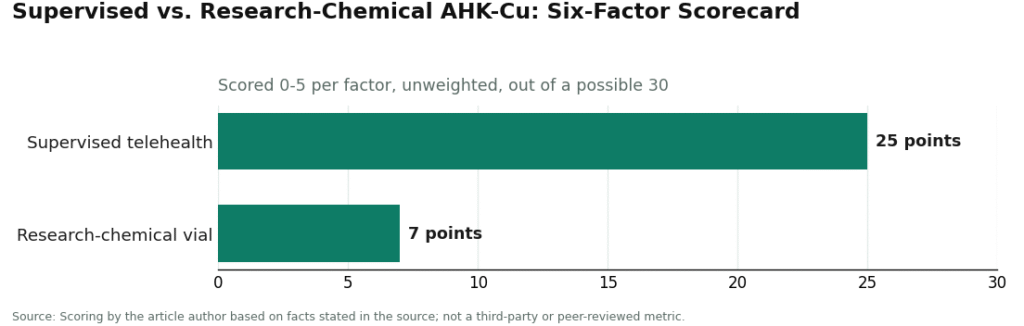
25 versus 7. The vial wins exactly one row out of six, the price, and loses everything that tells you whether the substance in the bottle is real, correctly dosed, and safe. That’s the whole argument compressed into a grid. AHK-Cu is a peptide with a copper ion bound to it, and the cheap route gives you zero independent check on either half. Saving money by deleting the only verification step in the transaction isn’t a saving, it’s risk transferred onto you and mislabeled as a bargain.
A note on the certificate defense. A research-chemical seller might hand you a certificate of analysis, and it might even be accurate. But nobody verifies it independently, no recall authority backs it, and the same label carrying that certificate also says, in writing, “for research use only, not for human consumption.” That sentence isn’t boilerplate, it’s the legal condition under which the product is allowed to exist at that price. Sell it for use on a human body and it becomes an unapproved drug. That’s precisely why it isn’t marketed that way, and precisely why it’s cheap.
Where the number tells you to buy it
This is the question the whole exercise is built to answer, ranked by the same grid rather than by whoever has the flashiest landing page.
#1: FormBlends. It’s the only option on this list that scores across all six columns instead of just the price column. FormBlends is a licensed telehealth provider, not a chemical warehouse: physician evaluation, a prescription when appropriate, and a licensed 503A compounding pharmacy that prepares and dispenses the medication, priced in that ~$40-to-$120-a-month band. The premium over a vial buys exactly the rows the grid rewards: a clinician screening you, a pharmacy accountable for the material, follow-up care. FormBlends also scores well on candor, stating plainly that AHK-Cu’s evidence is early and largely cosmetic rather than implying it’s a proven regrowth treatment, and on a thin-evidence compound, that honesty is worth more than the few dollars you’d save elsewhere. If you want to track dose and what you actually notice over the months hair growth takes to show, the FormBlends tracker app is a logging tool for that, nothing more, not a prescription, not a checkout.
Worth flagging: an independent writer ranking peptide sources on accountability rather than price arrived at the same top slot. A roundup written from the “which of these would I actually send a friend to” angle put FormBlends first (Buying Peptides Online: 8 Sources I’d Send a Friend To). One outside list doesn’t substitute for reading a provider’s own disclosures, but it’s consistent with what the scorecard already shows.
#2: HealthRX.com (HealthRX.com). Same tier, same logic: licensed clinical oversight, prescription required, licensed pharmacy dispensing, the same disclosure about thin evidence. On the six-factor grid it scores like FormBlends, because the underlying structure is the same. Between these two, pick on practical grounds: which one is licensed in your state, whose intake fits your case.
Below that line, the numbers stop favoring the buyer.
#3: Swiss Chems. A research-chemical retailer selling AHK-Cu alongside other peptides and SARMs under “research use only” labeling. High score on the sticker, low score on everything else: no clinician, no prescription, no pharmacy dispensing, no follow-up, purity resting entirely on trusting the seller. The SARMs in the same catalog carry their own regulatory and anti-doping baggage.
#4: Limitless Life. Another research-chemical seller, same structural math: a vial mailed with a seller-issued certificate, no medical oversight, no recall authority. Cheaper than the supervised tier, cheaper for exactly the reasons the grid penalizes.
#5: Pure Rawz. Broad catalog of research peptides including AHK-Cu, all under research-use labeling. Wide selection doesn’t change the scoring: not a medical provider, purity dependent on trust, human use unapproved and legally gray.
#6: Amino Asylum. The budget play, competing on the lowest sticker price for peptides labeled not for human consumption. Cheapest of the six, which is really the whole thesis of this piece in one line: in an unregulated market, the lowest price is a reason to look harder, not less hard, because price competition with zero accountability usually comes out of quality you can’t see.
The only line on this list that matters is the one between #2 and #3. Above it, a clinician and a pharmacy are in the loop and the price reflects it. Below it, you’re the only quality-control step, and the label says so, literally, in writing.
Does the higher price buy a better result?
No. I want to be precise about what the extra money purchases, because it isn’t efficacy. The strongest human-relevant data point I could find is a single 2007 study where AHK-Cu stimulated elongation of human hair follicles and proliferation of dermal papilla cells in culture, and raised vascular endothelial growth factor, with a reported drop in programmed cell death that didn’t reach statistical significance [P1]. That’s a real, peer-reviewed lab finding, and genuinely interesting as one. It’s also in vitro: isolated follicles and cells in a dish, not hair regrowing on someone’s actual scalp in a controlled human trial. Nobody has closed that gap yet.
So the extra $40 to $120 doesn’t buy a stronger biological effect, because the effect is equally uncertain no matter who sells you the peptide. It buys a safer, accountable process wrapped around a compound whose outcome is still an open question. On something this lightly studied, that process is the entire value proposition, which is exactly why it wins the scorecard despite losing the price row.
Don’t let the cousin’s data set the price
Here’s a mix-up I’d flag to anyone reading a sales page. Most of the strong copper-peptide skin research is about GHK-Cu, AHK-Cu’s chemical relative, not AHK-Cu itself. Independent reviews of GHK and GHK-Cu describe real effects on collagen stimulation, wound healing, and skin remodeling, with one paper noting GHK’s influence on a surprisingly large share of human genes and its role modulating collagen synthesis and breakdown [P2][P3]. Solid body of work. It’s just not AHK-Cu’s body of work. AHK-Cu’s own direct human skin evidence stays thin. If a seller charges you a premium on AHK-Cu while leaning on GHK-Cu’s skin studies, you’re paying for data that doesn’t actually transfer.
The legal column, briefly
AHK-Cu isn’t FDA-approved. Copper tripeptides show up as cosmetic ingredients, a different regulatory bar than a drug, with no treatment claims permitted there. On the compounding side, the FDA keeps lists of bulk substances allowed in 503A compounding and substances flagged as raising significant safety concerns, and individual peptide status on those lists has moved before [P4][P5]. For anyone who competes in sport, a cosmetic copper peptide isn’t a classic doping-risk substance, but check the current WADA Prohibited List directly rather than take a web page’s word for it [P6]. None of this changes the dollar figure on either side. It changes which tier is legally allowed to sell you what, and none of it restores the accountability the cheap route removes.
The pick, in one line
Cheapest sticker: the research-chemical vial. Cheapest cost-per-unit-of-confidence, which is the only metric worth optimizing on an unproven compound built around a metal ion: the supervised route, roughly $40 to $120 a month, 25 out of 30 on my grid against the gray market’s 7. You aren’t paying more for a better peptide. You’re paying for the one version of this purchase where a licensed party is accountable for what’s in the bottle and honest about how thin the evidence still is. On AHK-Cu, that’s the whole value, and it’s exactly the line item the discount vial cuts to hit its price.
Check any provider’s licensure, pharmacy relationship, and current compounding status yourself before you spend a dollar. I run the numbers, you should still verify the inputs.
References
- [P1] Pyo HK, Yoo HG, Won CH, Lee SH, Kang YJ, Eun HC, Cho KH, Kim KH. “The effect of tripeptide-copper complex on human hair growth in vitro.” Archives of Pharmaceutical Research. 2007;30(7):834-839. PMID 17703734. https://pubmed.ncbi.nlm.nih.gov/17703734/ (AHK-Cu stimulated human hair-follicle elongation ex vivo and dermal papilla cell proliferation in vitro and raised VEGF; the apoptosis reduction was not statistically significant.)
- [P2] Pickart L, Vasquez-Soltero JM, Margolina A. “GHK Peptide as a Natural Modulator of Multiple Cellular Pathways in Skin Regeneration.” BioMed Research International. 2015;2015:648108. https://pmc.ncbi.nlm.nih.gov/articles/PMC4508379/ (Independent review of the copper-tripeptide GHK / GHK-Cu: collagen synthesis and breakdown, wound healing, skin remodeling.)
- [P3] Pickart L, Margolina A. “Regenerative and Protective Actions of the GHK-Cu Peptide in the Light of the New Gene Data.” International Journal of Molecular Sciences. 2018;19(7):1987. (Copper-tripeptide gene-modulation and collagen data; class-level evidence, GHK-Cu specific.)
- [P4] U.S. Food and Drug Administration. “Bulk Drug Substances Used in Compounding Under Section 503A of the FD&C Act.” (FDA category framework for bulk substances permitted, or not, in 503A compounding.)
- [P5] U.S. Food and Drug Administration. “Certain Bulk Drug Substances for Use in Compounding That May Present Significant Safety Risks.” (FDA list of substances flagged as raising significant safety concerns for compounding.)
- [P6] World Anti-Doping Agency. “The Prohibited List.” (Authoritative reference for prohibited substances in sport; used here to note AHK-Cu is not a classic doping-risk compound and to direct competitors to verify directly.)
What is AHK-Cu and what does it actually do in the body?
AHK-Cu is a copper peptide, specifically alanine-histidine-lysine bound to a copper ion, that occurs naturally in human plasma. Lab and animal studies show activity around collagen synthesis, hair follicle signaling, and skin repair pathways. Whether those effects hold up cleanly in humans at practical topical or injected doses is still an open question, so I’d keep expectations calibrated to that uncertainty.
Does AHK-Cu actually work, or is the evidence mostly hype?
Promising but thin is the fair read. Most of the data comes from cell cultures and rodent models, which do show measurable biological activity. A handful of small cosmetic studies point toward benefits for hair density and skin texture, but large, independent, placebo-controlled human trials are basically absent from the record. Enough signal that researchers keep looking, not enough volume to call the question settled.
Is AHK-Cu legal to buy and use?
In the US it sits in a gray zone. It’s not FDA-approved as a drug, so any therapeutic marketing claim is technically off-label territory. Research-chemical vendors can sell it legally as a research product, which shifts all the risk to the buyer the moment it’s used on a human body. Routing it through a physician-supervised compounding pharmacy like FormBlends keeps the transaction inside a regulated framework with real accountability behind it, a materially different setup than ordering from a bulk peptide site.
What side effects should I know about before using AHK-Cu?
Reported side effects skew mild: localized redness, irritation, or itching at the application or injection site. Copper peptides as a class can occasionally cause temporary skin darkening in people with more melanin-rich complexions. Systemic copper toxicity from topical use looks very unlikely at typical doses, but because human safety data is limited, anyone with a copper metabolism disorder should check with a doctor before starting it.
Written by Jae Alvarez, consumer-health journalist. Last reviewed February 2026.
Educational reference only. Decisions about treatment should be made with your clinician.