1. Connor Wanted a Smaller, Better Shoe Rotation
Connor noticed the problem on a Saturday morning while looking for something to wear to brunch.
There were plenty of pairs by the door, but only two felt like easy choices. One looked too much like gym footwear. Another was comfortable enough for errands but seemed out of place once he put on a clean jacket. A few others had barely left the apartment in months.
He lived in Chicago and worked in a creative office where nobody expected a suit. Most days were somewhere in the middle: jeans or trousers, a shirt or knit, maybe an overshirt when the weather turned. After work, he might walk to dinner instead of heading straight home.
He did not need more options. He needed fewer pairs that could handle more of that routine.
So he started paying attention to the pairs he reached for without thinking. That turned out to be more useful than looking at what seemed impressive lined up on a shelf.
2. His Priorities Started to Change
For years, Connor bought footwear the way a lot of people do. Something caught his eye, he imagined a few outfits around it, and that was usually enough.
That approach worked until his closet filled up.
When he began looking at designer shoes more carefully, branding moved lower on his list. He cared more about whether the sole looked balanced under straight-leg pants, whether the heel stayed secure, and whether the upper had enough structure to hold its form after regular wear.
The shift was gradual.
He still liked recognizable details. He just stopped treating recognition as the main reason to buy something.
One pair he had ignored for months became a favorite once he noticed how easily it worked with dark denim and a navy jacket. Another, which had seemed far more exciting at first, stayed home because the proportions never looked quite right with his clothes.
That was when the difference between liking a shoe and actually using it became obvious.
See also: How Technology Reshapes Economic Systems
3. Everyday Wear Became the Real Test
Tuesday became Connor’s unofficial test day.
He would wear a pair to the office, walk six or seven blocks for lunch, stand on a train platform, stop for groceries after work, and sometimes meet a friend for dinner. Nothing about the day was unusual, which was exactly the point.
A pair that worked only for the first hour usually revealed itself fast.
Maybe the heel began to move. Maybe the sole felt harder once he had been on concrete for most of the afternoon. Sometimes the problem was visual instead. A shoe that looked sharp in the mirror at 8 a.m. could start to feel too sporty once the rest of the day moved into restaurants, meetings, and evening plans.
Connor became less interested in the perfect first impression.
He wanted the pair that still made sense at 7 p.m.
4. One Pair Had to Work Across Different Settings
Versatility sounded vague until Connor began defining it around actual places.
For him, luxury sneakers for everyday wear needed to survive a casual office, a coffee shop, a long walk, and dinner without looking as if they belonged to only one of those settings.
That did not mean choosing the plainest option.
He liked texture, paneling, and unusual construction when they felt deliberate. What he avoided were pairs that forced everything else to change. If a shoe only worked with one cut of pants or needed a very specific jacket to feel balanced, he knew it would probably spend too much time in the closet.
One afternoon he tried the same pair with washed denim, charcoal trousers, and olive chinos. None of the outfits looked especially styled.
That was a good sign.
He was not trying to build outfits around footwear anymore. He wanted footwear that could enter outfits already in rotation.
5. Jeans Made the First Comparison Easy
Denim became the quickest filter.
Connor usually started with two pairs: dark straight-leg jeans and a faded blue pair with a little more room through the leg. If a shoe looked awkward with both, he rarely kept thinking about it.
The test exposed things that product photos could hide.
A thick sole might look dramatic from the front but feel oversized once the jeans settled over it. A narrow toe could look polished in isolation, then disappear under a wider hem. Sometimes the problem was the collar height. Sometimes it was simply that the shoe looked too busy next to worn denim.
He also began checking the side view more often.
That angle mattered once he was walking. The line from the heel to the forefoot, the height of the midsole, and the amount of upper visible below the hem changed the whole feel of the outfit.
None of that required a complicated styling formula. Jeans just made the proportions easy to see.
6. Comfort Shows Up After a Full Day
Five minutes in front of a mirror never told Connor much about comfort.
A full workday did.
He started noticing small things: whether his heel stayed planted while walking quickly, whether the front had enough room late in the afternoon, and whether the sole bent where his foot actually wanted to bend.
Weight mattered more than he expected.
Some heavier pairs felt solid at first, then became tiring after a few miles. Other pairs were light but felt thin on hard sidewalks. Chicago pavement was not especially forgiving, and long stretches downtown could make a minor weakness feel much bigger.
He also stopped assuming that softer meant better.
A cushioned footbed could feel great initially, but if the shoe moved around too much, it was still annoying by the end of the day.
Eventually his comfort standard became very ordinary: he wanted to forget about what was on his feet.
That was harder to achieve than it sounded.
7. Design Matters More When the Rest of the Outfit Is Simple
Most of Connor’s clothes were quiet.
He wore crewneck sweaters, Oxford shirts, plain tees, dark denim, loose trousers, and simple jackets. That gave designer shoes room to do more without making the entire outfit feel busy.
The details he liked became easier to identify.
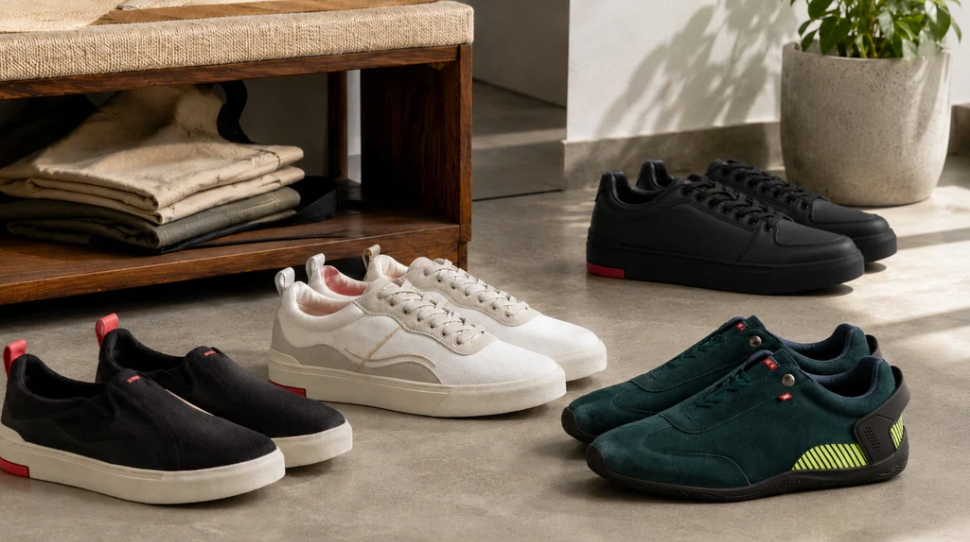
A stitched panel wrapping around the side. A slightly raised heel section. A sole that changed thickness without becoming chunky. Leather next to suede. Small things that gave the pair character from a few feet away.
He did not need a huge logo to notice good design.
In fact, some of his favorite pairs became more interesting the longer he owned them. The first impression was clean. The second came from the construction.
That suited him better than something that delivered everything at once.
He still had room for bolder footwear, especially on weekends, but the pairs that lasted in his regular rotation usually had one or two clear ideas rather than five competing ones.
8. First Impressions Became Less Important
Connor used to know within thirty seconds whether he wanted something.
Now he distrusted that feeling a little.
If a pair immediately looked exciting, he tried to imagine the boring version of owning it. Wednesday morning. Rain in the forecast. The same pants he wore last week. A quick lunch between meetings. No carefully planned outfit.
Would he still reach for it?
That question eliminated more options than expected.
He also looked at the back of a shoe now, which he almost never did before. A strange heel shape or oversized rear section could change the profile once he was moving. The same was true of a tongue that sat too high.
None of these details were deal-breakers by themselves.
The difference was that Connor had stopped evaluating footwear as an object. He was evaluating how it behaved once it joined everything else he already owned.
9. Every Pair Needed a Clear Role
By spring, the rotation had started to organize itself.
One pair was the obvious office choice. Another worked better on weekends. One had enough structure for travel but still felt relaxed once he checked into a hotel and went back out for dinner.
That was when Connor started looking at designer sneakers by role instead of treating every new pair as a possible all-purpose answer.
The change made shopping easier.
If something looked great but duplicated a pair he already used three times a week, he had less reason to add it. If a new option filled a gap—perhaps lighter for warm weather or slightly sharper under trousers—it made more sense.
There was no spreadsheet and no rigid system.
He just wanted to know why a pair belonged there.
If the answer took too long to explain, it usually did not.
10. Travel Quickly Revealed What Worked
Airports were brutal judges.
A weekend trip could mean standing in a security line, walking through two terminals, sitting for hours, carrying a bag across a hotel lobby, then going straight back outside.
Connor learned that shoes behaved differently when there was no easy backup pair nearby.
A stiff collar that felt fine during a short commute could become irritating after a flight. Heavy construction became noticeable once he had been walking all afternoon. Very pale or delicate materials sometimes made him think too much about weather and dirty sidewalks.
Packing changed too.
He used to bring three pairs for a short trip because he wanted options. Now two usually felt like enough.
One handled most of the day. The other covered whatever the first one could not.
That left more room in the bag and made getting dressed easier in the morning.
11. Loud Details Did Not Always Mean Better Style
Connor never lost his interest in statement pieces.
He just became harder to impress.
Oversized branding, exaggerated soles, glossy materials, and contrasting panels could all work. The problem came when too many of them showed up at once.
Some shoes seemed to be asking for attention from every angle.
He found that tiring after a while.
A bolder pair stayed interesting when the design had a clear hierarchy. Maybe the sole was the main feature and everything above it stayed controlled. Maybe the upper carried the detail while the bottom remained simple.
That felt more considered.
Connor stopped asking whether someone across the room would notice his footwear. He cared more about whether he would still like the pair after seeing it fifty times.
That was a surprisingly useful filter.
12. Daily Use Became More Important Than Display Value
The pairs that impressed Connor most were not always the ones that looked best sitting untouched.
He began favoring premium sneakers for daily wear because repeated use told him far more than presentation ever could.
A good pair survived ordinary things.
Coffee runs. Office floors. A long grocery stop. A quick dinner. A Sunday afternoon spent walking through the neighborhood without a plan.
Those moments were not glamorous, but they made up most of his week.
He also paid more attention to how materials handled regular use. Some finishes looked better once they softened slightly. Others showed every mark and made him overly cautious.
Connor did not want to be careless with his belongings, but he did not want to feel nervous wearing them either.
For him, the ideal pair could look special without needing to be treated like an exhibit.
13. Recognition Can Come From Proportion and Construction
After a while, Connor could recognize certain design approaches before noticing a brand name.
He saw the shape of a toe, the angle of a heel counter, the way panels overlapped near the midfoot, or the line where the upper met the sole.
Those details began to matter more.
They also helped him understand his own taste.
He preferred moderate visual weight, clean transitions, and construction that looked intentional from the side. He liked contrast, but usually in material or texture rather than in five different colors at once.
Once he understood that, browsing became faster.
A pair could be beautifully made and still not be for him. That no longer felt like a contradiction.
Taste became less about ranking products and more about recognizing what fit the way he already dressed.
14. Connor’s Rule Became Simple
By the end of the year, Connor owned fewer pairs than he had at the beginning.
He did not miss the extra choices.
His rule had become uncomplicated: the pair needed to work with clothes already in the closet, stay comfortable through a real day, and cover more than one part of his normal week.
If it did those three things, he paid attention.
If it required a special outfit every time, felt good only for an hour, or looked better on a shelf than on the street, he usually passed.
The result was not a perfectly curated collection. There were still favorites, impulse decisions, and days when he wore the easiest thing by the door.
That was probably why the system worked.
He was building a rotation for his actual life, not an imaginary one.
On most Tuesday mornings, the right pair was simply the one he could put on and leave the apartment without thinking twice.